
In heat exchanger maintenance, certainty matters. Whether you’re responding to an unexpected tube failure or performing planned outage work, the integrity of your tube plugging solution directly impacts safety, uptime, and cost control. One of the most common questions we hear from maintenance teams and reliability engineers is straightforward:
How do I know the plug has been installed correctly?
It’s a valid concern. Traditional plugging methods often leave room for ambiguity, requiring visual inspection, pressure testing, or even rework to confirm a proper seal. Torq N’ Seal plugs were designed to eliminate that uncertainty by building verification directly into the installation process itself.
The Challenge with Conventional Verification Methods
Many tube plugging solutions rely on expansion, welding, or compression-based sealing. While effective in certain applications, these methods often lack immediate, definitive installation feedback. As a result, crews may need to rely on:
- Visual cues that can be inconsistent or misleading
- Secondary testing procedures that add time and complexity
- Installer experience rather than a measurable, repeatable indicator
In high-pressure or critical-service environments, this uncertainty can introduce risk. If a plug is under-installed, it may not fully seal. If it’s over-installed, it can damage the tube or compromise long-term performance. Either scenario can lead to costly downtime or safety concerns.
A Built-In Feedback Mechanism
Torq N’ Seal plugs address this challenge with a fundamentally different approach: torque-based installation with immediate mechanical feedback.
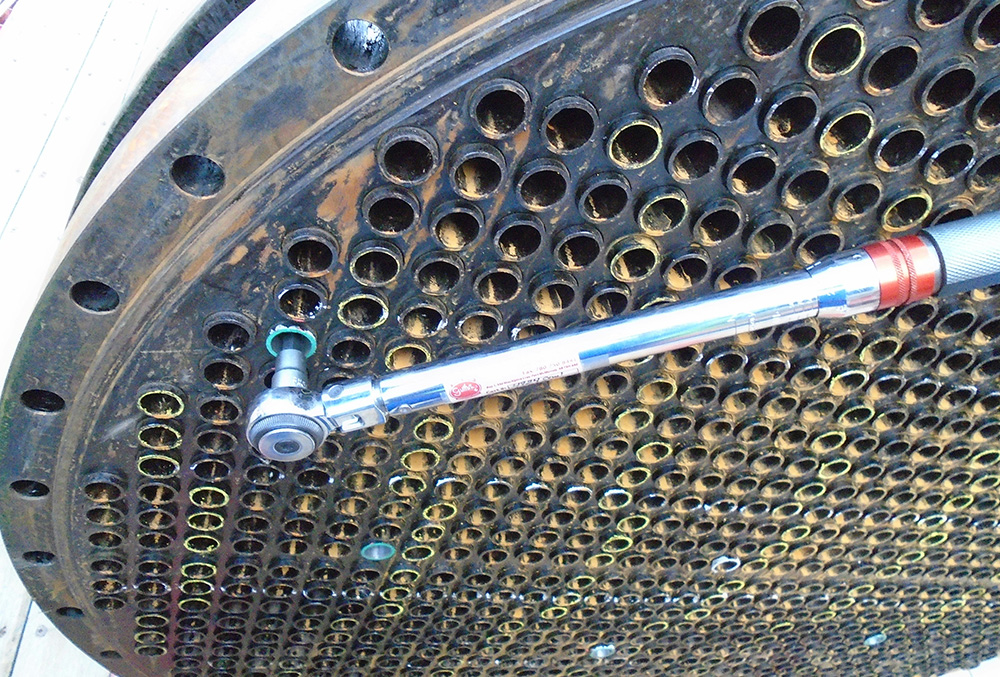
At the core of the design is an offset cam mechanism. As the plug is installed using a calibrated torque wrench, the cam engages with the internal diameter of the tube. This interaction is not linear. It follows an exponential torque curve, meaning resistance increases rapidly once the cam begins to properly bite into the tube wall.
This is where the key differentiator comes into play.
When the torque wrench reaches the specified installation value, it produces a distinct and familiar signal: the “click.”
That click is not just a tool function. It is a confirmation of proper installation.
What the “Click” Really Means
In the context of Torq N’ Seal plugs, the torque wrench click indicates three critical things have occurred:
- Cam Engagement
The offset cam has successfully contacted and gripped the tube ID. This ensures the plug is mechanically anchored and positioned correctly. - Transition to the Exponential Torque Curve
The installation has progressed into the high-resistance phase of the torque curve, confirming that sufficient force has been applied to create a reliable seal. - Achieved Sealing Performance
The plug has reached the engineered torque threshold required to seal the tube up to 7,000 psi.
This eliminates guesswork. There is no need to interpret visual cues or rely on installer judgment alone. The torque wrench provides a clear, repeatable, and measurable indication that the installation is complete and the seal is achieved.
Why Torque-Based Verification Matters
In real-world applications, tube conditions vary. Factors such as corrosion, ovality, scale buildup, and manufacturing tolerances can all impact the internal diameter of a tube. These variations can make consistent sealing more difficult, especially for solutions that depend heavily on uniform geometry.
Torq N’ Seal plugs are designed to adapt to these variations, and the torque-based feedback system ensures that adaptation is happening correctly.
Instead of asking, “Does this look right?” or “Did it expand enough?”, installers can rely on a standardized process:
- Apply torque
- Listen and feel for the click
- Move on with confidence
This consistency is especially valuable during large-scale outages or time-sensitive repairs, where efficiency and repeatability are critical.
Reducing Installation Errors and Rework
One of the most significant benefits of this approach is the reduction of installation errors.
Because the torque wrench provides immediate feedback:
- Under-installation is minimized – the plugging isn’t considered complete until the torque threshold is reached
- Over-installation is avoided – the wrench prevents excessive torque that could damage the tube
- Rework is reduced – fewer plugs need to be revisited or replaced due to uncertainty
For maintenance teams, this translates directly into time savings and improved reliability. Crews can work faster without sacrificing confidence in the result.
Simplifying Training and Standardization
Another advantage is how easily this method can be standardized across teams.
Training new technicians on traditional plugging methods can take time, particularly when installation quality depends on subjective judgment or experience. With Torq N’ Seal, the process becomes much more straightforward:
- Use the specified torque wrench
- Set the correct torque value
- Install until the wrench clicks
This simplicity reduces the learning curve and ensures that installations are consistent regardless of who is performing the work. It also makes it easier to document procedures and maintain quality control across different sites or contractors.
Built for High-Pressure Confidence
The ability to verify a seal up to 7,000 psi during installation is not just a convenience, it’s a critical performance assurance.
In many applications, especially in refining, petrochemical, and power generation environments, pressure conditions can be severe. Knowing that each plug has been installed to a verified torque corresponding to a 7,000 psi seal provides peace of mind that the exchanger can return to service safely.
Rather than relying solely on post-installation pressure testing, operators gain confidence at the moment of installation.
A Smarter Approach to Tube Plugging
The question of verification doesn’t need to be complicated. By integrating feedback directly into the installation process, Torq N’ Seal plugs provide a smarter, more reliable way to ensure proper sealing.
The torque wrench click serves as a simple but powerful confirmation:
- The plug is engaged
- The seal is formed
- The performance standard is met
In an industry where precision and reliability are essential, that level of clarity makes a meaningful difference.